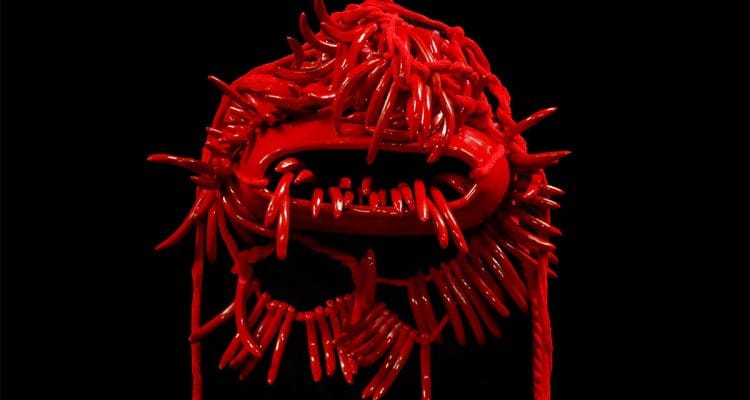

For their exhibition at Écart, fernando belote (FERN) presents an unruly installation, based on ceramics and lettering, which challenges colonial norms of the body and representation. At the center of the space, a carnivalesque sculpture of a mouth—open, sharp, almost incantatory—acts as a symbol of transformation. It refers to a sharp vocabulary, a set of signs that queers and decolonizes the Lusophone imagination, fragmenting Portuguese syntax into acts of queer resistance. This mouth becomes the visual emblem of a linguistic gesture: honouring Bajubá.
A sociolect in constant transformation, Bajubá was initially disseminated by Jovanna Baby in 1992, then named in collaboration with Georginha de Mamãe and Joinha da Rocinha. Derived from the sacred and multicultural languages spoken in the terreiros of Candomblé and other forms of quilombamento, this language encodes dissidence through an anti-colonial break with syntax. It constitutes a mode of Afro-trans communication now adopted by all Brazilian LGBTQIAPN+ communities: a heritage that demands reparation, recognition, and a deep respect for its origins.
For FERN, Bajubá is part of Brazil’s intimate memory: a language learned on the streets as a strategy for coping with domestic violence, shaped in the very heart of the peripheral communities where they grew up. […]
(original text by fernando belote)